August 4, 2026 · Lance Black
The evidence-backed AEO checklist: what to fix first

Most AEO checklists are flat. They place a blocked search crawler beside a speculative formatting trick even though the crawler problem deserves attention first.
A useful plan orders work by dependency and evidence. First make the facts retrievable. Then make them understandable. Then strengthen corroboration outside the site. Measure throughout, and label experiments as experiments.
How the evidence grades work
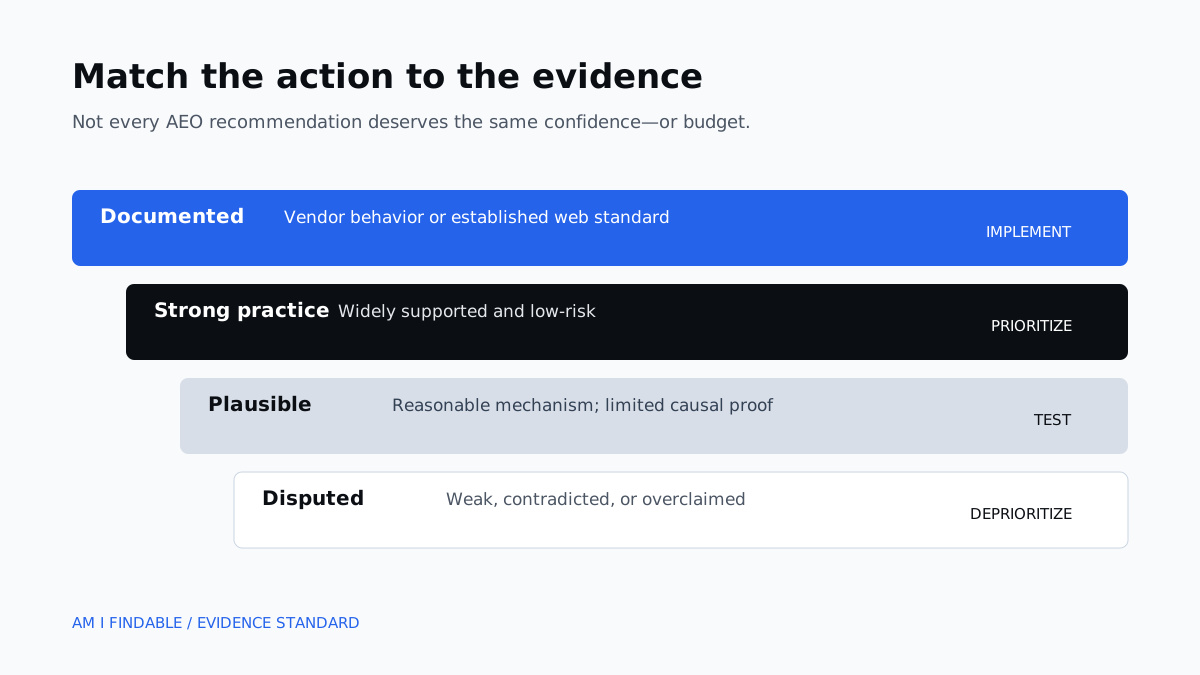
We use four levels:
| Grade | Meaning | How to act |
|---|---|---|
| Documented | An engine documents the mechanism, or it is observed directly in production data | Fix confidently when relevant |
| Strong practice | Multiple sources agree and the mechanism is sound | Prioritize after prerequisites |
| Plausible | Sensible but not isolated or measured | Run as a bounded experiment |
| Disputed | Evidence conflicts with the claim or points against it | Deprioritize or test only with a clear reason |
Evidence grade and business priority are different. A documented issue affecting an irrelevant page may matter less than a strong-practice issue on your pricing page. Use evidence, reach, effort, and reversibility together.
Priority zero: can engines retrieve the facts?
Check retrieval before rewriting copy.
Put essential content in the initial HTML
Vercel and MERJ’s December 2024 production study found that several prominent AI crawlers did not execute JavaScript across the sites and network they examined. Server-render product facts, pricing, service areas, specifications, comparisons, and FAQs.
Evidence: documented production observation.
Verify: compare the original HTML response with the rendered page.
Separate search bots from training bots
Allow or block each user agent according to its purpose. For example, OpenAI separates OAI-SearchBot from GPTBot; Google says Google-Extended does not control Search or AI Overviews.
Evidence: first-party documentation.
Verify: parse robots.txt for each named token and show its specific access status.
Check Bing eligibility
Confirm important pages are indexed in Bing and are not excluded from Copilot citation by NOARCHIVE or NOCACHE.
Evidence: documented discovery architecture and Bing guidance.
Verify: inspect Bing Webmaster Tools, index results, meta directives, and response headers.
Clean the sitemap and canonicals
List canonical, indexable 200-status URLs. Keep canonicals in initial HTML. Remove redirects, duplicates, and dead pages from the sitemap.
Evidence: strong mechanism plus production crawler data.
Verify: crawl the sitemap and compare each URL’s status, canonical, and indexability.
Priority one: can each passage stand on its own?
Answer engines often retrieve passages independently from the page’s full reading order.
Lead sections with the answer
A heading should state the question or subject. The opening sentence should answer it in plain language. Supporting evidence and nuance can follow.
Write the shortest complete answer the subject allows. Published engine documentation provides no universal 40–60-word target.
Use descriptive headings and a sequential hierarchy
Headings help readers scan and may help passage segmentation. Keep one H1, use H2s for major sections, and avoid skipping levels.
The accessibility case is strong; the AEO-specific effect remains unmeasured. Present heading improvements as structural clarity rather than a promised citation lift.
Use real tables for real comparisons
When rows and columns carry meaning, use semantic <table> markup. A styled collection of divs may look identical while losing those relationships in raw HTML.
Make the decision explicit
Include the details a comparison answer needs: who the product is for, who it is not for, current price, use cases, differentiators, limitations, and alternatives.
Documentation-style guidance such as “Choose X if…” and “Avoid it if…” is more useful than benefits copy because it resolves a decision.
Priority two: is the entity unambiguous?
Keep core facts consistent
Audit the name, description, address, service area, product names, pricing, and availability across your site and important profiles.
Consistency helps entity resolution while leaving room to describe the business naturally on each platform.
Maintain appropriate structured data
Use Organization, Product, Article, BreadcrumbList, and other relevant types when they match visible content. Add sameAs links to official profiles where appropriate.
Google says generative search requires no special schema. Appropriate schema can still reduce ambiguity and improve machine-readable factual consistency.
Correct high-impact factual gaps
Ask each platform branded questions about pricing, locations, eligibility, integrations, and limitations. Record incorrect statements and the sources attached to them. Fix owned facts first, then pursue corrections in recurring third-party sources.
Priority three: are trusted third parties saying it too?
Maintain category-relevant profiles
For B2B software, the recurring sources may include G2 and related comparison platforms. Consumer and local categories may rely more on Google Business Profiles, BBB, Trustpilot, Yelp, specialist directories, or trade associations.
Choose platforms based on observed source use in your category.
Earn placement in cited comparisons
Find listicles and comparison pages that recur in relevant answers. Correct outdated facts, offer useful data, or pitch inclusion when editorially appropriate.
Paid placement must be disclosed. A placement on a page no engine retrieves has little value, regardless of its domain rating.
Participate in communities without pretending to be a customer
Answer genuine questions on Reddit, Quora, and specialist forums when you have something useful to add. Disclose your affiliation. Avoid coordinated praise, invented experiences, and brand-approved “authentic” posts that hide payment.
Build a useful public record that helps the community even when no answer engine cites it.
Publish evidence others can reference
Original datasets, methods, calculators, directories, and clearly scoped experiments create stronger reasons to cite than another generic definition article. Publish null results too.
Monitor after every meaningful change
For each intervention, record:
- what changed and why;
- the evidence grade behind it;
- affected pages and prompts;
- implementation date;
- stable comparison window;
- observed result;
- alternative explanations.
Avoid changing ten things and attributing the outcome to your favorite one. Where possible, use unaffected pages, prompts, or markets as comparisons.
Popular tactics that belong in the experiment bucket
| Popular tactic | What the evidence supports | What to do |
|---|---|---|
Publish llms.txt to improve citations | SE Ranking found no citation effect across 300,000 domains in November 2025; Otterly recorded only 84 visits to the file among 62,100 AI-bot requests in a 90-day test | Use it as an experiment or human-readable convenience file after fixing retrieval, indexability, canonicals, and live URLs |
| Follow exact answer-length rules | Rules such as “write 40–60 words” or “name the subject within five words” come from vendor guidance rather than engine documentation | Write the shortest complete answer the subject allows, then test it with readers and retrieval checks |
| Add schema to guarantee citations | Appropriate schema clarifies machine-readable facts; Google describes its existing structured-data guidance as sufficient for generative features | Keep markup accurate, relevant, and consistent with visible content; evaluate it as a clarity improvement |
Tune sitemap priority and changefreq | Relevant engines provide no documented connection between these values and AI visibility | Spend the time removing redirects, duplicates, non-canonical URLs, and dead pages from the sitemap |
| Query your brand repeatedly to train recommendations | Repeated queries create monitoring observations; published evidence provides no mechanism for marketers to train recommendations this way | Use a fixed prompt set to measure outputs over time and invest optimization effort in retrievable facts and recurring sources |
Your first week
If the list still feels long, use this order:
Day 1: Test initial HTML, crawler policies, canonicals, directives, and Bing indexing on the five pages closest to revenue.
Day 2: Correct core business facts and structured data mismatches.
Day 3: Rewrite the weakest decision page into self-contained sections.
Day 4: Map recurring sources and missing third-party profiles.
Day 5: Establish a fixed prompt baseline and document the work.
Stop when the remaining actions are more speculative or expensive than the available evidence justifies.
Next: learn where off-site AI visibility comes from and how to earn it without astroturfing.