August 11, 2026 · Lance Black
AI visibility happens off your website: where to show up and why

Your website is the authoritative source for your own facts. Answer engines can also use third-party sources to decide which businesses belong in a comparison.
Commercial AI answers frequently cite reviews, editorial comparisons, directories, community discussions, videos, and other third-party material. That creates an opportunity and a temptation to manufacture consensus.
The durable strategy is narrower: identify the sources already appearing for your category, earn an accurate presence where you have something useful to contribute, and measure platform-specific changes without claiming that correlation proves influence.
Owned citation and third-party mention are different
An owned citation links to your website. It may help a reader verify a product fact, price, policy, or explanation.
A third-party mention appears on a source you do not control. It may corroborate quality, fit, reputation, or category membership.
Use both. Owned pages provide accurate primary facts. Independent sources add evidence about fit, reputation, and questions such as “Which option is best?”
Semrush and Kevin Indig’s June 2026 study examined 3,981 domain appearances and classified 61.7% of the citations as “ghost citations,” where the answer linked a domain without naming its brand. Track mentions, recommendations, citations, and referrals separately.
Find the sources already shaping your category
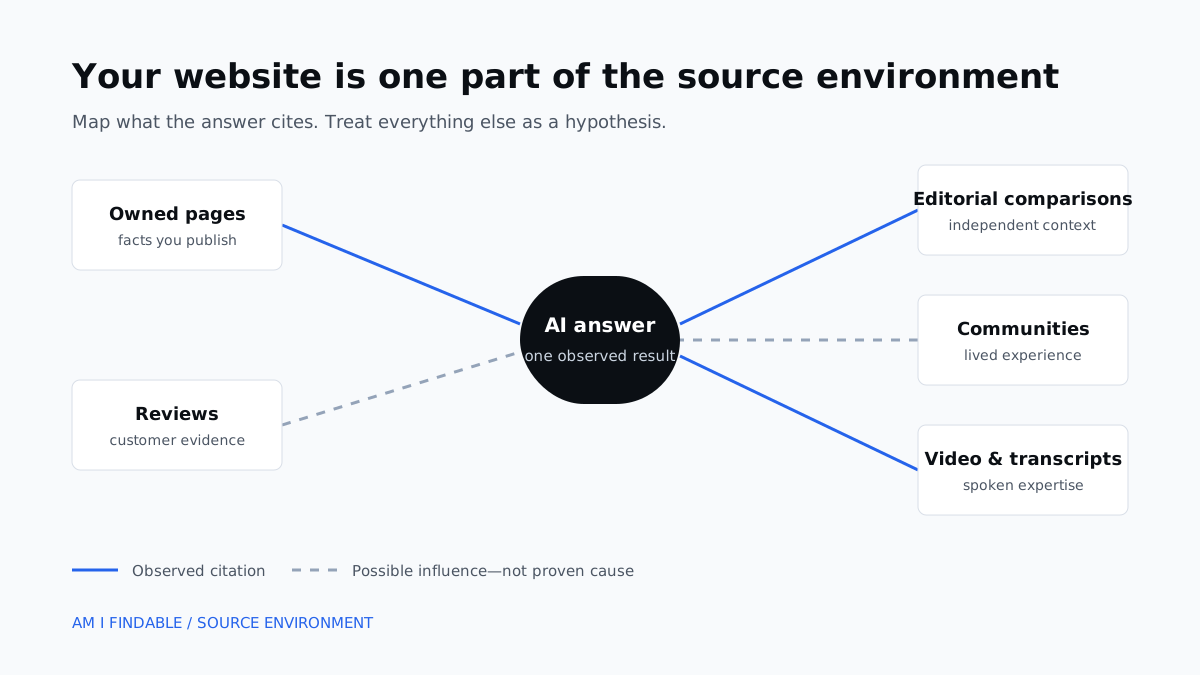
Build a source map before starting outreach.
- Select 10–20 questions across discovery, comparison, objections, and purchase intent.
- Run them on the platforms your buyers use.
- Save every cited URL and named source.
- Group sources by domain, type, platform, and question.
- Mark where your brand and competitors appear.
- Prioritize recurring sources tied to valuable questions.
Repeat important prompts. A source appearing once is an observation. A source recurring across runs and related questions is a stronger planning signal.
Report each engine separately because source pools differ. A YouTube strategy may matter enormously for Google AI Overviews and barely register in another platform during the same period.
Review platforms by business type
Reviews contribute structured facts, customer language, comparisons, and fresh evidence. The relevant platform depends on the category.
| Business type | Where to look first |
|---|---|
| B2B software | G2, Capterra, GetApp, Software Advice, specialist analyst directories |
| Local services | Google Business Profile, Yelp, BBB, local directories, trade associations |
| Consumer products | Retailer reviews, Trustpilot, specialist review publications, marketplaces |
| Travel and hospitality | Google, Tripadvisor, booking platforms, local editorial guides |
| Professional services | Industry directories, associations, credentialing bodies, local publications |
Treat these as places to investigate. Create or claim a profile only when the source appears in relevant answers or influences how buyers evaluate your category.
Claim the profiles that actually appear in your source map. Keep names, categories, locations, descriptions, and product details consistent. Respond to reviews helpfully. Treat any AEO effect from response volume as unmeasured.
Never buy or fabricate reviews. Aside from legal and platform risks, false consensus damages the source corpus everyone relies on.
Editorial comparisons and why placement matters
“Best of,” alternatives, and comparison pages are common sources for commercial answers. In May 2026, Peec AI reported an association between listicle rank and brand visibility after analyzing 5.7 million data points from nearly 200,000 responses across three industries and eight engines. Peec authored the vendor study and selected the markets; its results support prioritization rather than a universal causal claim.
Use the finding responsibly:
- identify comparisons actually cited for your buyer questions;
- check whether your absence or outdated description is material;
- contact the named author or editorial team with verifiable information;
- disclose sponsorship or payment;
- prefer a few relevant placements over bulk inclusion services;
- rerun the same prompt portfolio after enough time has passed.
Do not publish a self-serving “best products” article that ranks your own company first and call it independent evidence.
Reddit and Quora without astroturfing
Community discussions are attractive because assistants sometimes cite candid comparisons and problem-solving threads. They are also easy to abuse.
The ethical standard is straightforward:
- disclose employment, payment, or another material connection;
- answer the question before mentioning the product;
- include limitations and alternatives;
- never invent customer experience;
- respect subreddit and community rules;
- do not coordinate votes, replies, or fake consensus;
- do not revive irrelevant threads solely to place a link.
Semrush’s November 2025 study examined 248,000 Reddit URLs found across 217,000 prompts on Google AI Mode, Perplexity, and ChatGPT Search. Cited posts averaged about 900 days old, had a median length near 80 words, and typically received fewer than 20 upvotes. A useful answer can matter without viral engagement.
Paid community representatives require especially clear disclosure. The FTC treats payment, employment, gifts, and other material relationships as connections audiences should be able to see.
YouTube, podcasts, and transcripts
Video can be a major source for demonstrations, tutorials, pricing comparisons, and product reviews. Citation frequency varies sharply by engine, so validate it in your source map.
Create a video when the medium helps:
- demonstrate a process or physical product;
- compare workflows honestly;
- show setup, troubleshooting, or results;
- answer questions where visual proof matters.
Publish a clear title, description, chapter structure, and accurate transcript. The transcript makes the substance accessible to readers and retrieval systems. Do not turn every article into a talking-head video merely to create another URL.
Podcast appearances can create useful third-party context when episodes have accessible show notes or transcripts. The direct effect on AI visibility is plausible but not well isolated, so value the appearance for audience and authority first.
Earned editorial and original research
Give another publication something worth using, such as:
- original, well-scoped data;
- a transparent experiment, including a null result;
- an expert explanation tied to direct experience;
- a public calculator or benchmark;
- a maintained directory or dataset;
- a case study with absolute figures and limitations;
- a fast, factual response to a journalist’s question.
Publish the method beside the conclusion. State dates, sample size, exclusions, and the limits of the inference. A smaller transparent study is often more useful than an enormous unexplained counter.
A 30-day off-site visibility plan
Week 1: map
Run the stable prompt portfolio, collect sources, identify recurring domains, and separate owned from earned opportunities.
Week 2: correct
Fix inaccurate profiles and inconsistent company facts. Ask publications to correct objective errors. Do not begin with promotional requests.
Week 3: contribute
Choose two or three high-relevance opportunities: a substantive community answer, an expert response, a missing comparison entry, or a useful supporting asset.
Week 4: publish and baseline
Publish one first-party resource others have a reason to reference. Record dates and affected prompts. Schedule a comparable rerun rather than checking randomly every day.
How to measure progress honestly
For each platform, track:
- source recurrence across prompts and runs;
- brand mention and recommendation rate;
- owned and third-party citations;
- factual accuracy and sentiment;
- known referral sessions and conversions;
- newly earned placements;
- unrelated changes that could explain movement.
If your brand appears after a new article or community contribution, report both events. Do not say the placement caused the answer unless the design can support that conclusion.
The aim is to make accurate, useful information available in the places buyers and retrieval systems already consult.
Start the series from the beginning: Why does ChatGPT recommend your competitors instead of your business?