July 14, 2026 · Lance Black
Why does ChatGPT recommend your competitors instead of your business?

Ask ChatGPT for the best business in your category and a familiar competitor may appear while your company stays absent. Treat that result as the starting point for a diagnosis, then examine the pages and sources available for the answer.
Your competitor may have a pricing page the crawler could read. Several independent sites may describe its product consistently while your homepage, profiles, and directory listings disagree about what you sell. The model may also produce a different shortlist when you run the same question an hour later.
The short answer
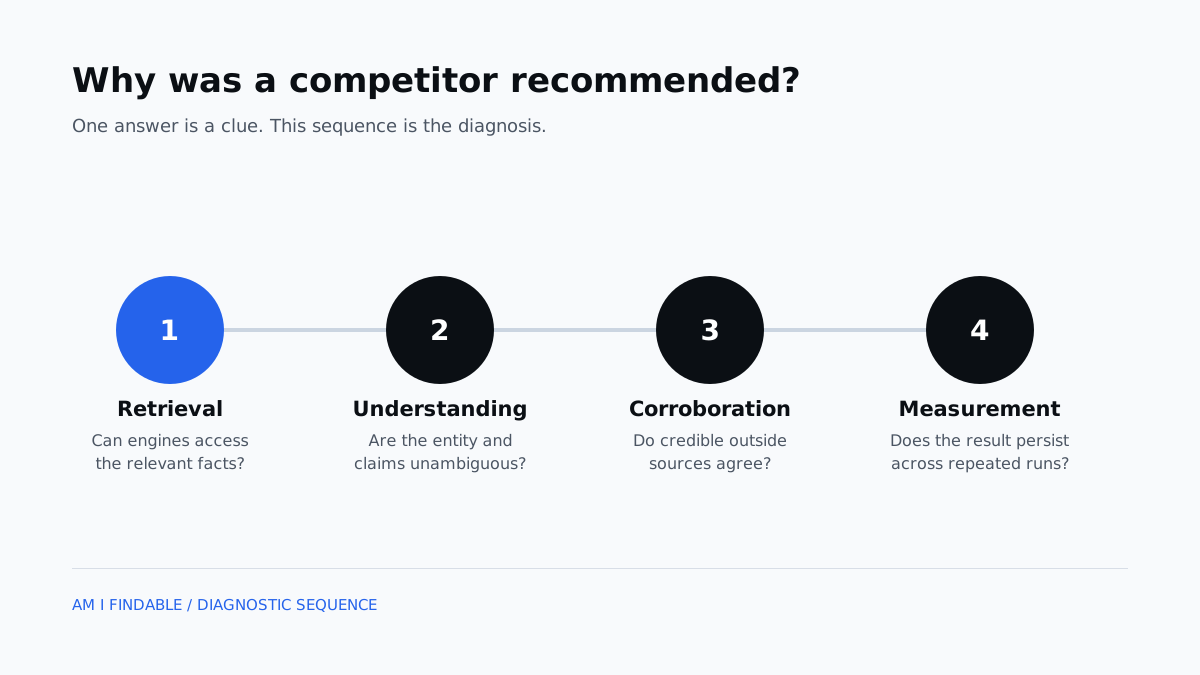
When an AI assistant recommends a competitor instead of you, check:
- Retrieval: Could the system reach the pages containing your important facts?
- Understanding: Is it unambiguous who you are, what you sell, and whom you serve?
- Corroboration: Do credible third parties describe or recommend you in the places this engine uses?
- Measurement: Does the gap persist across relevant questions, platforms, and repeat runs?
Together, those checks turn a screenshot into evidence you can act on.
Google rankings and AI inclusion follow different paths
Traditional search and AI answers overlap while using different product experiences and retrieval paths. A Google result page usually ranks documents. An AI answer may retrieve passages from several documents, combine them with model knowledge, and produce a new response. Some assistants search the web by default. Others search only for certain questions or modes. The same assistant may behave differently when a user enables a deeper reasoning or search mode.
That is why “we rank first on Google” and “ChatGPT recommends us” can both be true, both be false, or move independently.
SEO still matters. Crawlable pages, clear information, useful content, sound technical foundations, and third-party authority all help discovery. Google’s own guidance says there are no special requirements for appearing in its generative search features beyond established search fundamentals. The mistake is treating an organic position as a guarantee about a different interface.
1. Can the answer engine retrieve your site?
Start with the least glamorous possibility: the facts are present in the browser but absent from the HTML a crawler receives.
In its December 2024 production study with MERJ, Vercel observed that OAI-SearchBot, GPTBot, ChatGPT-User, ClaudeBot, PerplexityBot, Meta-ExternalAgent, and Bytespider did not execute JavaScript. If your pricing, product specifications, service area, or FAQ arrives only after a client-side request, a person can see it while one of those crawlers misses it. A broken canonical, stale sitemap, blocked search crawler, or Bing indexing problem can create a similar gap.
Check the page as delivered—not only as rendered:
- Is the essential copy present in the initial HTML?
- Does
robots.txtallow the search crawler relevant to the platform? - Is the canonical URL correct and server-rendered?
- Does the sitemap contain live canonical pages rather than redirects and 404s?
- Is the page indexed by Bing where Bing-supported discovery matters?
Crawler names need care. OpenAI documents OAI-SearchBot for search visibility separately from GPTBot, which controls potential training use. Google says Google-Extended does not control inclusion in Google Search or AI Overviews. A report that labels every AI-related user agent “blocked” without explaining its purpose can send you toward the wrong fix.
Retrievability makes the page eligible for consideration. Relevance and source selection determine whether it appears in a given answer.
2. Does the web agree on what your business is?
Compare the basic facts on your homepage, contact page, structured data, Google Business Profile, LinkedIn page, important directories, review profiles, and major coverage. Conflicting versions of the same company create an avoidable identification problem:
- official name and common brand name;
- one plain description of what you do;
- products or services and who they are for;
- address, service area, and contact information;
- current pricing or a clear explanation of how pricing works;
- current availability and important limitations.
Structured data can help machines parse these facts. Google says generative search uses existing SEO foundations and requires no special schema. Use appropriate Organization, Product, Article, or Breadcrumb markup when it matches visible content, and keep JSON-LD consistent with what visitors can see. Then ask a stranger to read one page and explain your business in a sentence; their answer exposes ambiguity faster than another round of brand copywriting.
3. Are credible third parties recommending your competitors?
For commercial questions, answer engines often use sources outside the company website: review platforms, trade publications, comparison pages, local directories, community discussions, videos, and earned editorial coverage.
Ask which sources appear in answers for the buyer questions that matter to you. That narrower question produces a usable outreach list.
Run a small source-gap review:
- Choose five questions a serious buyer asks before purchasing.
- Record the domains cited by each platform.
- Mark where competitors appear and where you do not.
- Separate sources you control from sources you must earn.
- Prioritize the few sources that recur across relevant answers.
This avoids a common waste pattern: placing the brand on dozens of low-value directories while missing the two comparison pages an engine repeatedly retrieves.
It also avoids a causal mistake. If a listicle is cited and a competitor is recommended, the listicle is a plausible influence—not proof that its placement caused the recommendation. Treat it as an informed outreach target, then measure what happens.
4. Does the result persist?
AI answers vary. Identical prompts can produce different brands and sources across runs. Results also change with location, model, date, search mode, and wording.
Before declaring a competitor “the winner,” build a compact baseline:
- Include branded and non-branded buyer questions.
- Cover discovery, comparison, objection, and purchase intent.
- Keep the prompt wording and platform settings stable.
- Run important questions more than once.
- Record mentions and citations separately.
- Compare platforms rather than blending them into one unexplained score.
This process makes the remaining uncertainty visible and the next test easier to choose.
The first three checks to run
If you have one afternoon, do these in order.
Check 1: Ask the questions that affect a sale
Avoid vanity prompts such as “What is Acme?” Use the questions a buyer asks while choosing:
- “What is the best [category] for [use case]?”
- “[Your company] versus [competitor]”
- “What are the drawbacks of [your company]?”
- “Which [category] works for [constraint]?”
Record the answer, named brands, cited pages, date, platform, and mode.
Check 2: Inspect the pages containing the missing facts
Look at the initial HTML, canonical, indexability, visible facts, and structured data. Fix a genuine retrieval failure before rewriting everything.
Check 3: Map the sources around the winning competitor
Identify recurring reviews, comparisons, publications, and community pages. Decide whether each gap calls for a profile correction, an editorial pitch, a substantive contribution, or no action.
What you can influence
You can make your facts retrievable, your identity consistent, your pages easier to extract, and your presence in credible sources stronger. Monitor whether your brand appears more consistently after the work, and keep the budget aimed at observable changes in retrieval, factual clarity, source coverage, and prompt results.
The next article in this series explains how to measure whether AI recommends your business, including the metrics that belong together and the ones that do not.